

Credit cards are often talked about as either good or bad. Some people see them as a path to rewards, travel, and convenience. Others see them as a dangerous way to build debt.
The truth is that credit cards are tools.
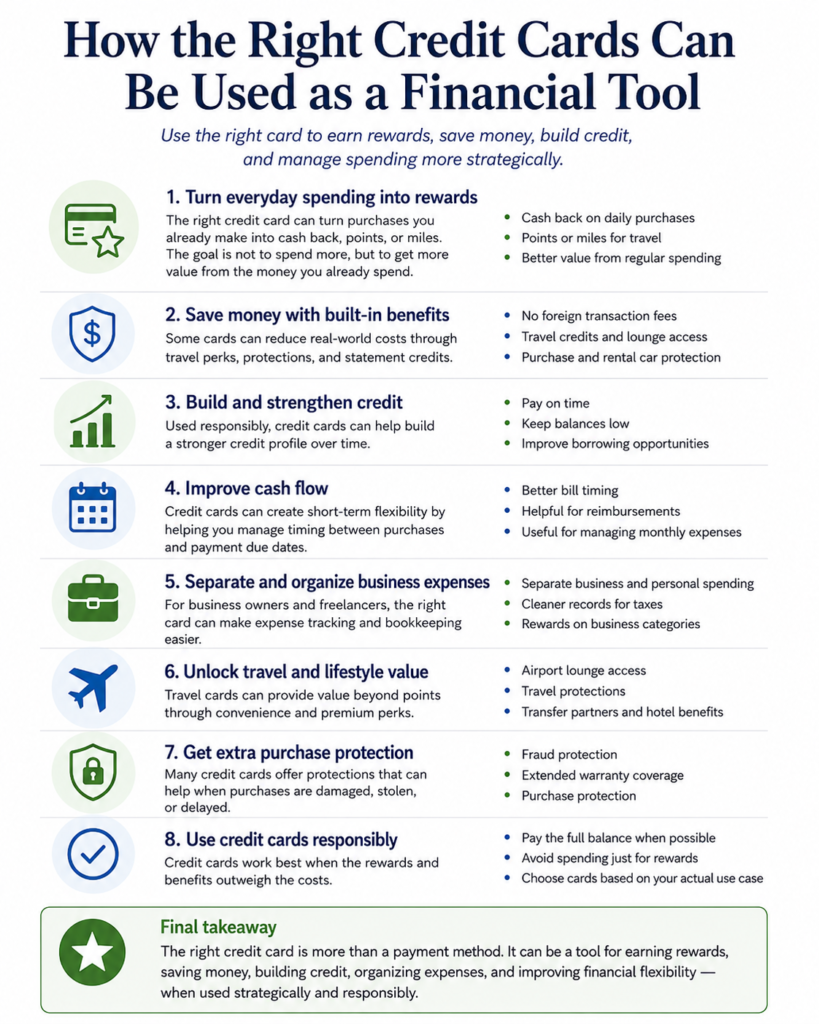
Like any tool, the result depends on how you use them. Used poorly, credit cards can become expensive and stressful. Used strategically, the right credit cards can help you earn rewards, protect purchases, manage cash flow, build credit, and unlock valuable benefits.
The key is choosing cards that match your spending habits, financial goals, and lifestyle.
Credit Cards Are Not Just for Spending
Many people think of credit cards only as a way to buy things now and pay later. But the best credit cards can do much more than that.
A well-chosen credit card can help you:
- Earn cash back, points, or miles on everyday spending
- Build or improve your credit profile
- Access travel protections and purchase protections
- Separate business and personal expenses
- Improve short-term cash flow
- Reduce certain fees and out-of-pocket costs
- Unlock perks you would otherwise pay for separately
When used responsibly, a credit card can become part of a broader financial strategy.
1. Credit Cards Can Turn Everyday Spending Into Value
Every month, most people spend money on groceries, gas, restaurants, utilities, travel, subscriptions, and household expenses.
The right credit card can turn that normal spending into rewards.
For example, one card may offer strong cash back on groceries. Another may be better for restaurants. A travel card may earn valuable points on flights and hotels. A business card may reward advertising, shipping, or software expenses.
Instead of using one random card for everything, you can choose cards based on where you spend the most.
That means your existing spending can produce:
- Cash back
- Travel points
- Airline miles
- Hotel rewards
- Statement credits
- Gift cards
- Business expense rewards
The goal is not to spend more. The goal is to earn more from the money you already spend.
2. The Right Card Can Help You Save Money
Rewards are only one part of the equation. Some credit cards can also help reduce costs.
Depending on the card, you may receive benefits such as:
- No foreign transaction fees
- Free checked bags
- Airport lounge access
- Travel credits
- Rental car insurance
- Cell phone protection
- Purchase protection
- Extended warranty coverage
- Introductory 0% APR offers
- Balance transfer options
For the right person, these benefits can be worth more than the annual fee.
For example, a frequent traveler may save money with a card that includes travel credits, lounge access, and rental car protection. A family may benefit more from a card with strong grocery rewards. A small business owner may benefit from a card that earns rewards on advertising, software, or shipping.
The “best” card is not always the most famous card. It is the card that saves you the most money based on how you actually live and spend.
3. Credit Cards Can Help Build Credit
Responsible credit card use can help build a stronger credit profile over time.
Your credit score can affect your ability to qualify for mortgages, auto loans, apartments, insurance rates, and other financial products. Credit cards are one of the most common tools people use to establish and strengthen credit history.
Good credit card habits include:
- Paying on time
- Keeping balances low
- Avoiding unnecessary debt
- Keeping older accounts open when appropriate
- Using credit regularly but responsibly
Credit cards can help show lenders that you are able to borrow money and repay it responsibly. Over time, that can improve your access to better financial opportunities.
4. Credit Cards Can Improve Cash Flow
Credit cards can also help with short-term cash flow.
This does not mean using credit cards to buy things you cannot afford. Instead, it means using the billing cycle strategically.
For example, if you make a purchase today, you may not have to pay the credit card bill for several weeks. That can give you more flexibility when managing income, expenses, invoices, or reimbursements.
This can be especially useful for:
- Business owners
- Freelancers
- Consultants
- Frequent travelers
- People who get reimbursed for work expenses
- Households managing large monthly bills
The important rule is simple: cash flow flexibility is helpful only if you can pay the balance in full by the due date.
5. Business Credit Cards Can Organize Expenses
For business owners, freelancers, and side hustlers, the right credit card can make financial tracking much easier.
A business credit card can help separate business spending from personal spending. That can make bookkeeping, tax preparation, budgeting, and expense management cleaner.
Business cards may also offer rewards in categories that matter more to companies, such as:
- Online advertising
- Office supplies
- Internet and phone services
- Shipping
- Travel
- Software subscriptions
- Restaurants and client meals
A business card can also give a company access to higher limits, employee cards, spending controls, and cleaner reporting.
Used properly, it becomes more than a payment method. It becomes an expense management tool.
6. Travel Cards Can Unlock Experiences
Some credit cards are especially powerful for travel.
Travel rewards cards can help you earn points and miles that can be used for flights, hotels, upgrades, rental cars, and other travel expenses. Premium travel cards may also include benefits that improve the travel experience itself.
These may include:
- Airport lounge access
- Global Entry or TSA PreCheck credits
- Travel insurance
- Trip delay protection
- Rental car coverage
- Hotel status
- Airline fee credits
- Transfer partners
- Free checked bags
For someone who travels often, these perks can be extremely valuable.
But travel cards are not automatically worth it for everyone. If you rarely travel, a simple cash back card may be a better tool. The right card depends on your goals.
7. Credit Cards Can Provide Extra Protection
Another benefit of credit cards is protection.
Many cards include protections that debit cards and cash do not offer in the same way. Depending on the card, you may get help if an item is damaged, stolen, delayed, defective, or if a trip is interrupted.
Common protections can include:
- Fraud protection
- Purchase protection
- Extended warranty protection
- Return protection
- Rental car insurance
- Trip cancellation or interruption coverage
- Lost luggage reimbursement
- Cell phone protection
These protections can make credit cards useful for larger purchases, travel bookings, electronics, business equipment, and online shopping.
8. The Wrong Card Can Cost You Money
Credit cards are only useful tools when the benefits outweigh the costs.
A card may be a poor fit if:
- The annual fee is higher than the value you receive
- The rewards categories do not match your spending
- You carry a balance and pay high interest
- You spend more just to earn points
- You do not use the benefits
- The redemption options are too complicated
- The card encourages habits that hurt your finances
The biggest mistake is choosing a card because it sounds prestigious instead of choosing one based on math.
A premium card with a high annual fee may be valuable for one person and completely unnecessary for another. A no-annual-fee cash back card may be the smarter choice for someone who wants simplicity.
9. The Best Credit Card Strategy Starts With Your Use Case
Before choosing a credit card, ask what job you want the card to do.
Are you trying to:
- Earn cash back?
- Travel more?
- Build credit?
- Finance a large purchase temporarily?
- Separate business expenses?
- Maximize grocery or gas rewards?
- Get airport lounge access?
- Protect purchases?
- Avoid foreign transaction fees?
- Manage reimbursable work expenses?
Once you know the use case, it becomes easier to compare cards.
The best card for a frequent traveler may not be the best card for a parent buying groceries. The best card for a business owner may not be the best card for a student building credit. The best card for someone who wants simplicity may not be the best card for someone who wants to maximize every rewards category.
That is why the right credit card is personal.
Rather than choosing a card based only on a headline bonus or a generic “best cards” list, it is usually better to compare options based on your actual needs. We recommend looking at cards through the lens of use case, spending category, and financial goal.
Tools like CardCompass.ai can be helpful because they organize credit cards around how people actually use them. That can make it easier to narrow down options and identify cards that may better fit your situation.
The goal is not to find the flashiest card. The goal is to find the card that works best for the way you already spend and the benefits you are most likely to use.
10. Credit Cards Work Best When Used Responsibly
No credit card reward is worth paying unnecessary interest.
The most important rules are:
- Pay your bill on time
- Try to pay the full balance each month
- Do not spend more just to earn rewards
- Watch annual fees
- Understand the benefits before applying
- Keep your credit utilization low
- Choose cards that fit your real spending
When you follow these rules, credit cards can work for you instead of against you.
Final Thoughts
The right credit cards can be powerful financial tools.
They can help you earn rewards, save money, build credit, protect purchases, organize expenses, improve cash flow, and unlock travel benefits. But the value depends on choosing the right card for the right purpose.
A good credit card strategy is not about having the most cards or chasing every bonus. It is about matching the card to your goals.
That is why using a tool like CardCompass.ai can be a practical next step. By comparing cards based on your use case and spending habits, you can make a more informed decision instead of relying on one-size-fits-all recommendations.
When used responsibly, credit cards are more than payment methods. They are tools that can help you get more value from the money you already spend.